Map a New Student Questionnaire to a First Lesson for Music Teachers

A new student questionnaire collects contact and emergency information, instrument details, prior experience, goals, scheduling preferences, practice habits, health or accessibility needs, and tuition preferences before the first lesson starts. Teachers use it to build a realistic first-week plan, set communication expectations with parents, and avoid the awkward guesswork that eats up early lesson time. Get this form right and everything downstream, from practice assignments to parent updates, gets easier.
TL;DR:
- Collecting detailed contact, instrument setup, prior experience, and health information ensures you can tailor lessons and avoid wasting early session time.
- Short, age-appropriate forms with clear sections help parents and students provide honest answers quickly, reducing abandonment and incomplete data.
- Using intake responses to set realistic goals, practice expectations, and communication routines from the start improves student progress and parent-teacher trust.
- Recording answers within a management system like Allegro streamlines lesson planning, progress tracking, and communication, saving administrative time.
Table of Contents
- Essential Fields To Include In A Student Background Questionnaire
- Building A New Student Intake Form: A Simple Template
- Turning Answers Into A First Lesson Plan And A Communication Routine
- Adjusting The Questionnaire By Age, Instrument, And Lesson Format
- Why A Structured Intake Form Changes How Students Practice
- Turn Intake Answers Into Practice Plans With Allegro
- Sources
- FAQ
Essential Fields To Include In A Student Background Questionnaire
A good student information sheet does more than collect names and phone numbers. Each field should answer a question you’d otherwise have to ask awkwardly mid lesson, or worse, discover you needed three weeks in.
Here’s what to include and why it earns its place on the form:
- Contact and emergency info. Who to reach, who pays the invoice, and who to call if a child gets hurt or needs picked up early. For students under 18, this is the parent; for adult learners, it’s often just a backup contact.
- Instrument and home setup. What the student actually owns and can practice on. A kid with a 61-key keyboard and no sustain pedal needs a different first assignment than one with a full acoustic piano.
- Previous experience and materials. What method books, teachers, or self-taught habits they’re bringing with them. This tells you what to build on and what bad habits to quietly unwind.
- Goals and motivation. Why they signed up. “Wants to play for a school talent show” and “wants to eventually accompany the church choir” call for very different repertoire choices in week one.
- Scheduling, cancellation, and make-up policy acknowledgment. Availability windows, plus a signed acknowledgment of your cancellation rules so nobody’s surprised later.
- Practice habits and commitment level. How many days a week they realistically expect to practice, and for how long. This sets goals you can actually hold them to.
- Health, learning differences, and accessibility notes. Anything from ADHD to a broken wrist to a hearing aid. Ask with a confidentiality note attached, and keep the tone matter of fact.
- Tuition, billing, and payment preferences. Who’s paying, how, and whether they want monthly invoices or per-lesson billing.
- Studio policy acknowledgments. Photo/video consent for recitals, lesson length options, and any studio-specific rules they need to sign off on before lesson one.
Sample forms from working studios, like this piano student information form, consistently converge on this same core set of fields. That’s not a coincidence. Skip one and you’ll be chasing the missing piece by email during week two.
Building A New Student Intake Form: A Simple Template
The cleanest new student intake form runs in this order: basic info, musical background, goals, schedule, practice habits, health and consent, then payment and policies. Keep sections short and skippable so a parent filling this out on a phone doesn’t abandon it halfway through.
Here’s a working structure with sample wording for each age group:
- Basic info. “Student name, age, and best contact number for lesson reminders.” For young children, add “Parent/guardian name” as a required field, not optional.
- Musical background. For kids: “Has your child taken music lessons before? What did they enjoy or dislike?” For teens and adults: “What instruments or method books have you used, and for how long?” Sample answer: “Two years of group piano lessons at school, mostly hated the recital pressure.”
- Goals. Ask open ended, not multiple choice: “What made you want to start lessons?” Sample answer from a teen: “I want to write my own songs eventually, but I know I need the basics first.”
- Schedule and preferences. “What days and times generally work, and do you prefer in-person or online lessons?”
- Practice habits. “How many days a week can you realistically commit to practicing, and for how long each time?” Be honest here works better than aspirational.
- Health, accessibility, and consent. “Is there anything about learning style, health, or accessibility we should know to make lessons work better for you?” Frame it as inclusive, not clinical.
- Payment and policies. Billing contact, preferred payment method, and a checkbox to acknowledge your cancellation and recital policies.
Pro Tip: For students under age 8, cut sections 2 through 4 down to two or three checkboxes each. A five-minute form gets filled out. A fifteen-minute form gets abandoned at question six.
Keep every question nonleading. Instead of “You’ll be excited to perform in recitals, right?” ask “How do you feel about performing for others?” and let the answer tell you something real.

Turning Answers Into A First Lesson Plan And A Communication Routine
The questionnaire is only useful if you actually act on what it tells you. Before the first lesson, scan for three things: stated goals, practice-habit honesty, and any health or learning note that changes how you’ll teach.
- Match stated goals to a first-week assignment. A student who wrote “I want to play my sister’s wedding song” gets a different opening piece than one who wrote “I just want to understand music theory.”
- Set your communication rhythm based on what parents indicated. If a parent noted they want weekly updates, decide now whether that’s a text, an email, or a short written note, and stick to it.
- Flag health or learning-support notes before the lesson starts, not during it. A note about sensory sensitivity to loud sounds changes how you introduce a metronome.
- Use the form to pre-build your admin. A goal of “read sheet music fluently” becomes a template checklist you reuse for every student with that same answer, cutting repetitive lesson-note writing.
Research on parent-teacher relationships in music lessons backs this up directly: a collective case study on parent-teacher partnerships found that trust, reciprocity, and shared decision-making separate the partnerships that work from the ones that quietly fall apart. A questionnaire is your first shot at establishing all three, before you’ve even met the family in person.
Adjusting The Questionnaire By Age, Instrument, And Lesson Format
A five-year-old piano beginner and a 34-year-old adult guitar student need different forms, not the same one with a few fields skipped.
- Use checkbox-heavy, one-page forms for young children; save the longer narrative-style intake for teens and adults.
- Add instrument-specific fields: amp and pedal setup for electric guitar, tuning frequency for acoustic piano owners, vocal health history for voice students.
- For online lessons, check camera and microphone quality, internet reliability, and get explicit consent if you plan to record sessions.
- Any health or disability question needs a one-line confidentiality note explaining who sees the answer and why you’re asking.
Why A Structured Intake Form Changes How Students Practice
Teachers who skip a real intake process tend to spend the first month guessing at expectations instead of teaching to them. I’ve seen the difference a structured form makes: when a parent states upfront that they can only realistically supervise 15 minutes of practice a night, the teacher who reads that note assigns 15 minutes of achievable material instead of a 45-minute wish list nobody follows.
That’s not just instinct. Research on expectations in music education recommends asking teacher, student, and parent about expectations early, specifically because it lets the teacher pick a communication pattern that actually holds up over months, not just the first week. Revisit your form once a year. What worked for your studio in 2023 might be missing a field you now ask about in every single consultation call.
— Dave
Turn Intake Answers Into Practice Plans With Allegro
Every field on your new student questionnaire has a home once you’re actually teaching, and that’s where most teachers lose the thread, juggling a paper form, a separate lesson notebook, and a group text with parents. Allegro Music Studio gives those intake answers somewhere to live: student profiles hold the goals and health notes you collected, lesson notes turn into practice assignments tied to what the student actually told you they wanted, and Encores package that progress into a parent-ready summary without you retyping anything.
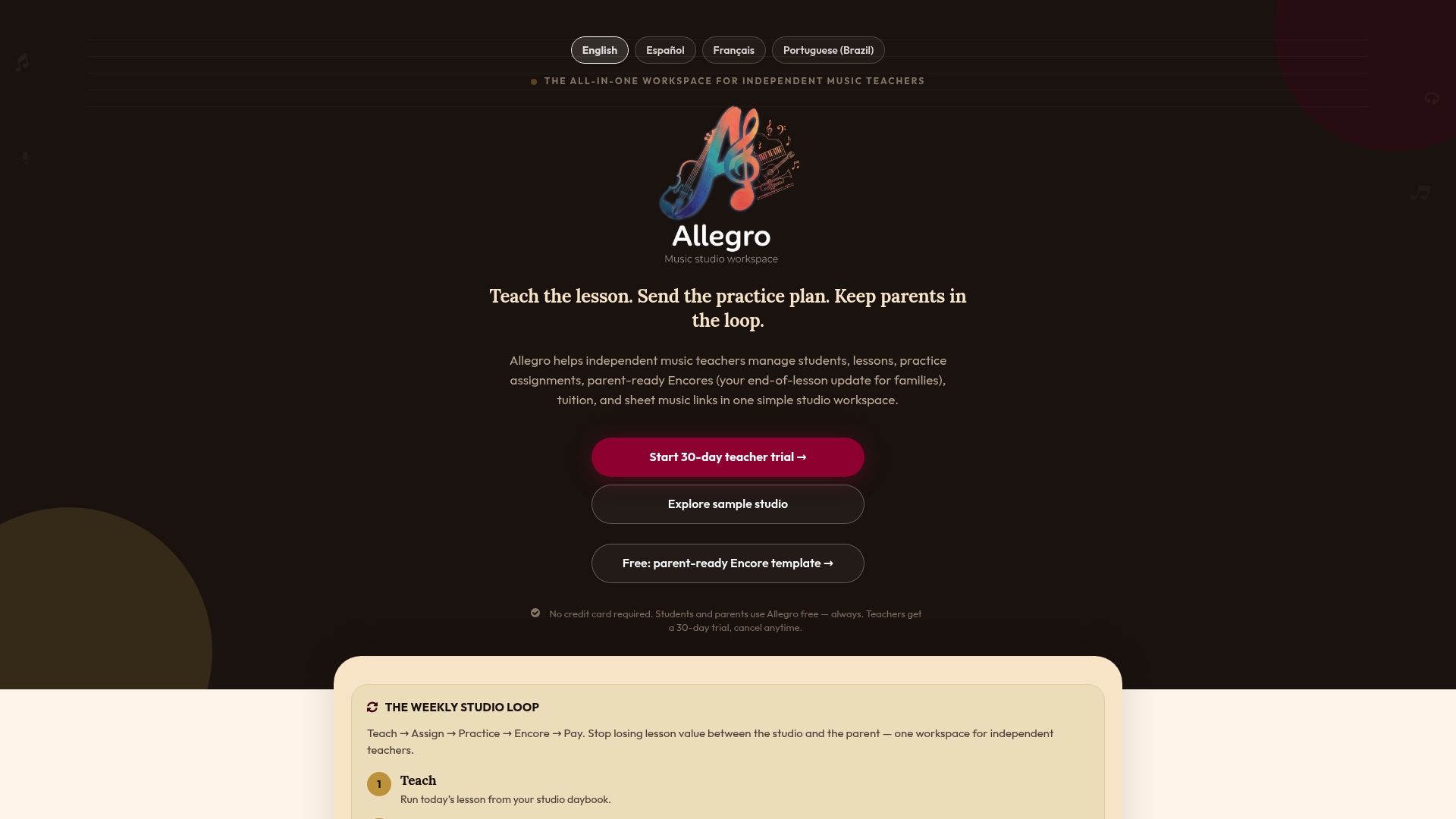
If a parent noted they want weekly updates, Encores handle that automatically instead of becoming another task on your list. Billing preferences from the form map straight into invoices and payment links, so tuition tracking isn’t a separate spreadsheet. Allegro’s Solo and Studio plans both start with a 30-day trial, and the free templates on the site are worth grabbing even if you’re not ready to commit. Try building your next new student’s profile there and see how much of the admin disappears on its own.
Sources
- Andrea Creech et al. — expectations research
- Parent–teacher partnerships in group music lessons: a collective case study — British Journal of Music Education
- Piano Student Information Form (sample PDF) — Hannah Eh Music
FAQ
What Should A New Student Questionnaire Include?
At minimum, collect contact and emergency information, instrument and home setup details, prior experience, goals, scheduling availability, practice habits, health or accessibility notes, and tuition preferences. Studio policy acknowledgments, like recital photo consent and cancellation rules, round out the form.
How Long Should A Student Intake Form Be?
For adults and teens, one page covering all core categories works well; for young children, cut it down to checkboxes across two or three sections so a parent can finish it in under five minutes. Longer forms tend to get abandoned partway through.
Should I Ask About Health Or Learning Differences On The Form?
Yes, but frame it as an open, confidential question rather than a clinical checklist, such as asking what would help lessons work better for the student. Include a short note on who sees the answer and why you’re asking, since this builds the trust that research on parent-teacher partnerships identifies as central to lessons that actually work.
How Do I Use Questionnaire Answers In The First Lesson?
Match stated goals to a realistic first assignment, and use the practice-habit answer to set achievable weekly targets rather than an aspirational schedule nobody follows. Flag any health or learning-support notes before the lesson, not during it, so you’re prepared going in.
Can Allegro Help Manage Intake Responses?
Allegro Music Studio lets teachers store student profiles, turn lesson notes into practice plans, and generate parent-ready Encores summarizing progress, all tied to the information collected at intake. Pricing and a 30-day trial are available on the Allegro site.