8–12 Parent Survey Questions Music Teachers Can Copy Paste Today

Send a short parent survey now, 8 to 12 questions covering practice support, communication preferences, scheduling, and tuition clarity. Skip the long, open-ended forms nobody finishes. The copy-ready questions below cover all four areas, plus two open text prompts for suggestions and concerns, so you can paste them into a form today.
TL;DR:
- More than a third of parent-involving practices are linked to increased motivation and satisfaction, making deliberate communication essential for better outcomes.
- Sending brief, topic-specific surveys at key points, like onboarding or after recitals, boosts response rates and provides actionable insights.
- Limiting surveys to 8-12 focused questions with Likert scales, multiple choice, and one or two open-text prompts helps parents respond efficiently.
- Quickly acting on urgent issues and summarizing changes back to parents builds trust and improves engagement over time.
- Allegromusic offers tools that streamline communication and billing, helping teachers easily implement survey feedback into their practice workflows.
Table of Contents
- Why Parent Survey Questions Actually Move the Needle
- Copy-Ready Parent Survey Questions By Topic
- Getting the Format and Timing Right
- Turning Responses Into Action Without Overthinking It
- A One-Semester Playbook Worth Copying
- How Allegromusic Helps You Act on What Parents Tell You
- Sources
- FAQ
Why Parent Survey Questions Actually Move the Needle
Parents who negotiate practice schedules, ask about progress, and build rapport with the teacher produce kids who enjoy lessons more and stick with them longer. A study of 337 parent-pupil-teacher trios found that structured home practice environments and regular parent-teacher communication predicted higher motivation and satisfaction across the board. That is not a soft finding. It is the strongest evidence available that involving parents deliberately, not just informing them after the fact, changes outcomes.
There is a catch. Teachers and parents often disagree on how much communication is actually happening. Research comparing teacher and parent reports found many parents say they rarely hear how much their child should practice, even when teachers believe they have made that clear. A survey closes that gap by asking directly instead of guessing.
Introducing the survey is simple. Try: “I want lessons to work better for your family. This takes three minutes and helps me adjust how I communicate and plan practice.” That’s it.
Pro Tip: Frame the survey as a tool for the child’s progress, not a report card on your teaching. Parents answer more honestly when it doesn’t feel like they’re grading you.

Copy-Ready Parent Survey Questions By Topic
Paste these directly into a form or a text message. They’re grouped so you can pull just the sections you need this term.
Practice support questions
A large self-report survey of families using independent music lessons linked parent involvement in practice directly to enjoyment and progress, so this section carries the most weight.
- My child practices at a consistent time most days. (Strongly Disagree to Strongly Agree, 5-point scale)
- I understand what my child should be practicing each week. (5-point Likert)
- I feel confident helping my child during home practice. (5-point Likert)
- My child seems motivated to practice without reminders. (5-point Likert)
- I know how many minutes per day my child should practice. (5-point Likert)
- The teacher gives clear, specific practice instructions after each lesson. (5-point Likert)
- Sometimes I feel like I have to nag or police practice time. (5-point Likert)
- What gets in the way of practicing at home? (Open text, one sentence)
Question 7 sounds blunt on purpose. Parents who feel like enforcers rarely say so unprompted, but plenty admit it when asked directly, and that’s exactly the friction a teacher can coach around.
Communication preference questions
- How would you prefer to receive lesson updates? (Multiple choice: text, email, printed note, in-app summary)
- How often would you like progress updates? (Multiple choice: after every lesson, weekly, monthly)
- Do you feel informed about what your child is working on right now? (5-point Likert)
- Is the current communication style clear and easy to understand? (5-point Likert)
Scheduling questions
- Is your current lesson time still the best fit for your family? (Yes/No/Somewhat)
- How much notice do you need for a schedule change? (Multiple choice: 24 hours, 3 days, 1 week or more)
- Is the cancellation and makeup policy clear to you? (5-point Likert)
Tuition and billing questions
- Are invoices clear and easy to understand? (5-point Likert)
- Is the current payment method convenient for you? (Multiple choice: card, bank transfer, check, other)
- Do you feel tuition reflects the value of lessons? (5-point Likert)
Open feedback
- What is one thing you’d like to see change this term?
- Any other comments or concerns?
That’s 20 items across five groups. Most studios won’t use all of them at once. Pick 8 to 12 based on what’s actually unclear right now, not everything you could theoretically ask.
Getting the Format and Timing Right
Length kills more surveys than bad questions do. Keep the whole thing to 8 to 12 items and aim for a 3 to 5 minute completion time. Anything longer and busy parents abandon it halfway through.
Match format to the question. Likert scales work for anything measuring agreement or satisfaction. Multiple choice fits preferences with a fixed set of answers, like communication format or payment method. Open text should be rare, one or two fields at most, reserved for suggestions or concerns that don’t fit a scale.
Timing matters as much as length:
- Send an onboarding survey in the first two weeks, focused on communication preferences and scheduling fit.
- Run a six-week check covering practice support and early satisfaction.
- Send a short pulse survey right after a recital, when parents are engaged and emotions are still fresh.
A one-line reminder 48 hours after the initial send usually recovers a meaningful chunk of non-responders. Small incentives help too. A subject line like “3 minutes, help shape next term” outperforms anything that sounds like homework.
Pro Tip: Send surveys from your personal teaching account, not a generic studio email address. Response rates jump when parents recognize who’s asking.
Turning Responses Into Action Without Overthinking It
Responses sitting in a spreadsheet do nothing. Here’s a three-step process that takes under an hour for a studio of 20 to 30 families.
- Triage urgent items first. Anything flagging a scheduling conflict or a billing error gets a same-week reply. These are fixable fast and erode trust fastest if ignored.
- Group and rank recurring themes. Sort open comments and low Likert scores into buckets: practice support, clarity of expectations, communication frequency. A theme showing up across roughly one in ten responses deserves a studio-wide change, not just a one-off reply.
- Act, then report back. Pick two or three changes you can actually make this term, and send parents a short paragraph summarizing what you heard and what’s changing.
That last step is the one most teachers skip, and it’s the one that builds the most trust. A quick note along the lines of “here’s what we heard, here’s what we’re adjusting” does more for parent confidence than the survey itself.
A One-Semester Playbook Worth Copying
Run three short surveys per term: onboarding in week two, a practice-focused check at week six, and a quick pulse after the recital. Each one takes parents under five minutes.

Sample announcement: “Quick favor, three minutes on practice and communication so I can support [child’s name] better this term. Link below.” Simple, specific, done.
One caution worth repeating: questions about practice can easily sound like judgment on the parent rather than support for the student. Word them toward coaching, not compliance, and parents answer more honestly.
How Allegromusic Helps You Act on What Parents Tell You
Allegromusic is built for exactly the gap a survey exposes: parents who want clearer updates and teachers who don’t have time to write them by hand every week. Lesson notes turn into parent-ready summaries called Encores, so once a survey tells you parents want more frequent updates on practice, you’re not starting a new habit from scratch, you’re already generating the content lesson by lesson.
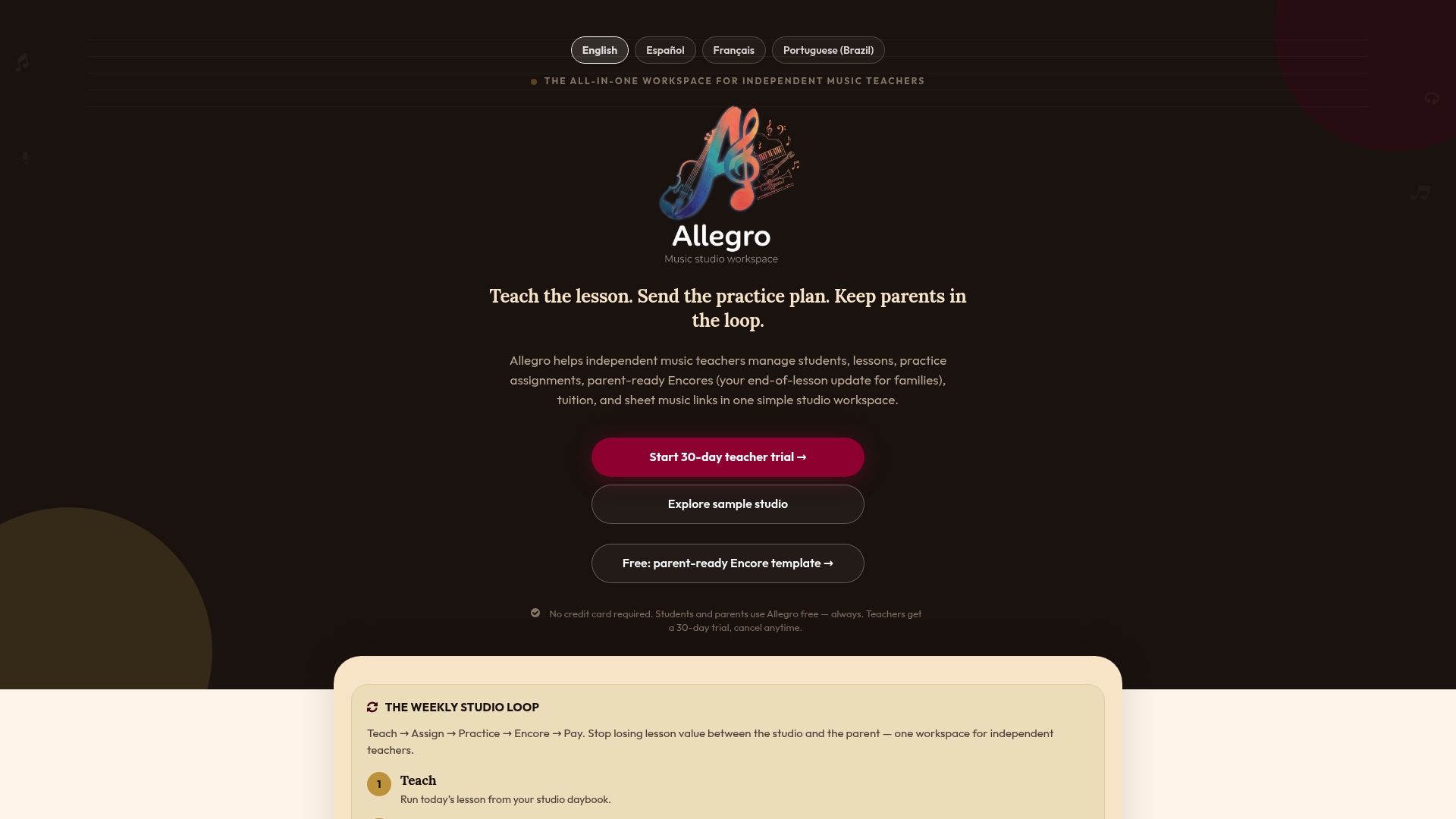
Beyond communication, Allegromusic handles the tuition-clarity complaints that show up in almost every parent survey, with invoice and payment link tools built into the same workspace where you manage lessons and assignments. Less time spent on admin between lessons means more time actually addressing what your survey told you to fix. The Studio plan runs $39 per month after a 30-day trial, and the Solo plan is available for teachers running a smaller roster, with pricing available on request. If your last parent survey turned up complaints about unclear practice expectations or scattered updates, that’s your sign to try the free templates and instrument demos and see whether Encores solve the problem before your next survey cycle even starts.
Sources
- Learning a musical instrument: the case for parental support
- Parental involvement in children’s independent music lessons: Music Education Research
- Music Practice Habits: Teacher, Parent, and Student Perspectives
FAQ
How many questions should a parent survey for music lessons have?
Aim for 8 to 12 questions total, split across practice support, communication, scheduling, and tuition. That length keeps completion time around three to five minutes, which is the range most parents will actually finish.
What question types work best for parent surveys?
Five-point Likert scales work well for satisfaction and agreement questions, multiple choice suits fixed preferences like communication format, and one or two open text fields cover suggestions or concerns. Mixing all three keeps the survey quick without losing nuance.
How often should I send a parent survey?
Three times a term works well: once during onboarding, once around the six-week mark, and once after a recital or performance. Each one can focus on a different topic instead of repeating the same long form.
How do I get parents to actually respond?
Keep it short, send it from a personal account rather than a generic studio address, and follow up once after 48 hours. A specific subject line naming the time commitment, like “3 minutes on lesson feedback,” tends to outperform a vague one.
Can Allegromusic help me send and act on parent surveys?
Allegromusic isn’t a survey tool itself, but it directly supports what most surveys reveal parents want: clearer, more frequent updates and simpler billing. Lesson notes convert into parent-ready Encores automatically, and invoicing tools live in the same workspace, so acting on survey feedback takes less extra work.