Music Teachers: Copy Paste Onboarding Templates and Encore Recaps

Student onboarding is a two-phase process, administrative first, then pedagogical, that turns a stranger into a committed student before the first lesson ends. Handle billing, policies, and scheduling before the student walks in; save the first lesson for assessment, rapport, and a quick musical win. The single highest-impact move is a same-day recap with three items: what happened, what to practice, and the next date. Miss that, and even a great lesson fades from memory by dinner.
TL;DR:
- Most students report that adding a playlist before lessons improves their experience and creates a sense of belonging, especially when tailored to their genre interests.
- A same-day recap of practice items and next lesson dates significantly increases retention, with missing it leading to fading memories of the lesson.
- A structured onboarding process, including intake forms and a short first lesson assessment, reduces early drop-off and builds better rapport from the start.
- A 4-week onboarding program is better suited for long-term students, as it fosters weekly habits and provides multiple data points for progress tracking.
- Centralizing lesson notes, practice tasks, and parent updates in one workspace helps maintain consistency and prevents important details from being lost.
Table of Contents
- What Is Student Onboarding for Music Lessons?
- How Do You Split Admin Work From Teaching Time?
- What Does a Copy-Paste Onboarding Checklist Look Like?
- Single-Lesson Intake or a 4-Week Onboarding Program?
- Can a Playlist Actually Speed Up Student Bonding?
- How Allegro Music Studio Turns Lesson Notes Into Parent-Ready Updates
- Speed Versus Personalization When Your Calendar Is Already Full
- Try Allegro Music Studio for Your Next Onboarding Cycle
- Sources
- FAQ
What Is Student Onboarding for Music Lessons?
Onboarding is the structured process of turning an inquiry into an engaged, paying student, covering everything from the first phone call to the fourth or fifth lesson. Done well, it does two jobs at once: it locks in the logistics (payment, scheduling, policies) and it builds the personal read a teacher needs to actually teach the kid in front of them, not a generic beginner.
The payoff shows up in retention. Practitioner checklists built specifically for independent music teachers treat onboarding as a distinct phase precisely because skipping it causes drop-off in the first month, not the sixth. A short musical ritual at the start of a relationship also does more than most teachers assume: surveys on classroom music find that most students report it makes the experience feel more welcoming from minute one.
What changes by format:
- In-person lessons: you can run assessment and rapport-building live, so front-load the pedagogical read.
- Online lessons: technical setup (audio quality, camera angle, shared documents) has to be confirmed before the first note plays.
- Group classes: onboarding shifts from one deep intake to a lighter, faster version repeated across several students at once.
How Do You Split Admin Work From Teaching Time?
Mixing paperwork into lesson time is how policies get forgotten and lessons run short. The fix is a hard split: everything administrative happens on the intake call or in a form, before the student’s name ever goes on your calendar for a real lesson.
Before the lesson (administrative):
- Capture the lead’s contact info, instrument, and availability in one short conversation.
- Send a 2-minute intake form covering age, prior experience, goals, and any physical or scheduling constraints.
- Share your studio policies (cancellation, makeup, payment) in writing, not verbally.
- Confirm payment method and lock the first appointment on the calendar.
During the first lesson (pedagogical):
- Run a quick technical assessment: posture, rhythm sense, reading level.
- Ask the student to describe, in one sentence, how they learn best.
- Record their stated goal in their own words, not your paraphrase.
Practitioner guidance on structured onboarding checklists recommends exactly this order: intake before you meet, assessment once you do.
Pro Tip: Never ask a new student to fill out a form while the clock is running. It signals that their lesson time is worth less than your paperwork, and that’s the opposite of what onboarding should communicate.
What Does a Copy-Paste Onboarding Checklist Look Like?
Here’s a sequence you can lift directly into your own studio, from first contact to the fourth week.
Lead capture script: “Thanks for reaching out. I’ll send a 2-minute form to get [student]'s goals and schedule, then we’ll set up a first lesson.” Immediately follow with the intake form.
Trial booking: Offer 2 to 3 time slots, not an open calendar. Take payment at booking, even a small deposit, since a paid trial credited toward tuition on enrollment reduces no-shows more reliably than a free slot. Send a calendar invite plus a reminder 24 hours out.
First-lesson plan, drawn from proven onboarding structures for music teachers:
| Minutes | Focus |
|---|---|
| — | Rapport building, quick chat |
| — | Assessment: posture, rhythm, reading |
| — | Focused teaching toward one quick win |
| — | Practice plan and booking conversation |
| — | Confirm next date and payment |
Same-day recap (send within a few hours): what we covered, two practice items with a tempo or repetition goal, and the next lesson date.
4 to 6 week email sequence: message one restates policies now that trust exists, message two shares a practice tip tied to their goal, message three introduces makeup/cancellation logistics again, and a final message around week five checks in on progress and invites questions. Staggering these keeps families from drowning in details on day one, a structure backed by research on onboarding pacing.

Single-Lesson Intake or a 4-Week Onboarding Program?
The right model depends on what the student actually wants from you, not on what’s easiest to administer.
- Single-lesson intake fits casual learners, adults testing the waters, or anyone who wants to “try before committing.” It’s low-friction: one assessment, one recap, and a decision point.
- 4-week onboarding fits beginners, kids, and anyone the studio wants to retain long-term. A structured multi-week onboarding package builds the weekly habit before you ever ask for a standing commitment, and it gives you four data points on the student instead of one.
On pricing: many studios charge a flat onboarding or trial fee for the single-lesson model, then convert that fee into a registration fee once the student enrolls, so nobody feels like they paid twice. A 4-week package is usually priced as its own short-term product, separate from standard monthly tuition, which sets clear expectations about what happens after week four.
Can a Playlist Actually Speed Up Student Bonding?
A shared playlist is one of the cheapest, fastest ways to build belonging before a student has learned a single scale. Universities have used this exact tactic: a collaborative welcome playlist sent to incoming students created a shared sense of ownership over campus culture before anyone met in person. The same trick works at studio scale.
Three versions worth running:
- A welcome playlist you send in the first onboarding email, built around the student’s stated genre interests.
- A student-curated “entry song” they pick to open each lesson, which doubles as a mood check.
- A thematic pre-lesson track tied to whatever technique or piece is coming up that day.
Most surveyed students say music played before class improves the learning experience and creates a more positive atmosphere, according to research on classroom playlists.
That number holds up in separate research on music as a class-opening ritual, which found the same pattern of high positive perception across different classroom settings. A simple template for your onboarding email: “Here’s a playlist to get you excited for lessons, add a song you love and I’ll try to work it into a future assignment.”
How Allegro Music Studio Turns Lesson Notes Into Parent-Ready Updates
A checklist only works if it survives contact with a full week of back-to-back lessons. That’s the gap Allegro Music Studio was built to close: intake details, lesson notes, assignments, and invoices live in one workspace instead of scattered across texts, spreadsheets, and memory.
The core mechanic is the Encore, a parent-ready recap generated from your own lesson notes:
- What we did: a plain-language summary of the lesson’s focus.
- Practice items: two specific tasks with a tempo or repetition goal attached.
- Next step: the date of the next lesson and what to expect.
That structure matches the same-day recap habit that keeps new students engaged past the first month, except it’s generated from notes you were already taking, not an extra task bolted onto your evening.
Speed Versus Personalization When Your Calendar Is Already Full
Capture commitment first, personalize the follow-up second. That order matters more than people admit: a fast, slightly generic intake form beats a beautifully personalized email that goes out three days late, because the student has already mentally moved on. The daily habit of a short recap, even five rushed sentences, is what actually earns the second month of tuition.
— Dave
Try Allegro Music Studio for Your Next Onboarding Cycle
Most studios lose new students not from bad teaching but from silence between lessons, a missed recap, a forgotten policy reminder, an invoice nobody sent. Allegro Music Studio is built specifically to close that gap: student profiles, lesson notes that convert into Encores, assignment tracking, and tuition invoices with payment links, all in one workspace instead of five apps.
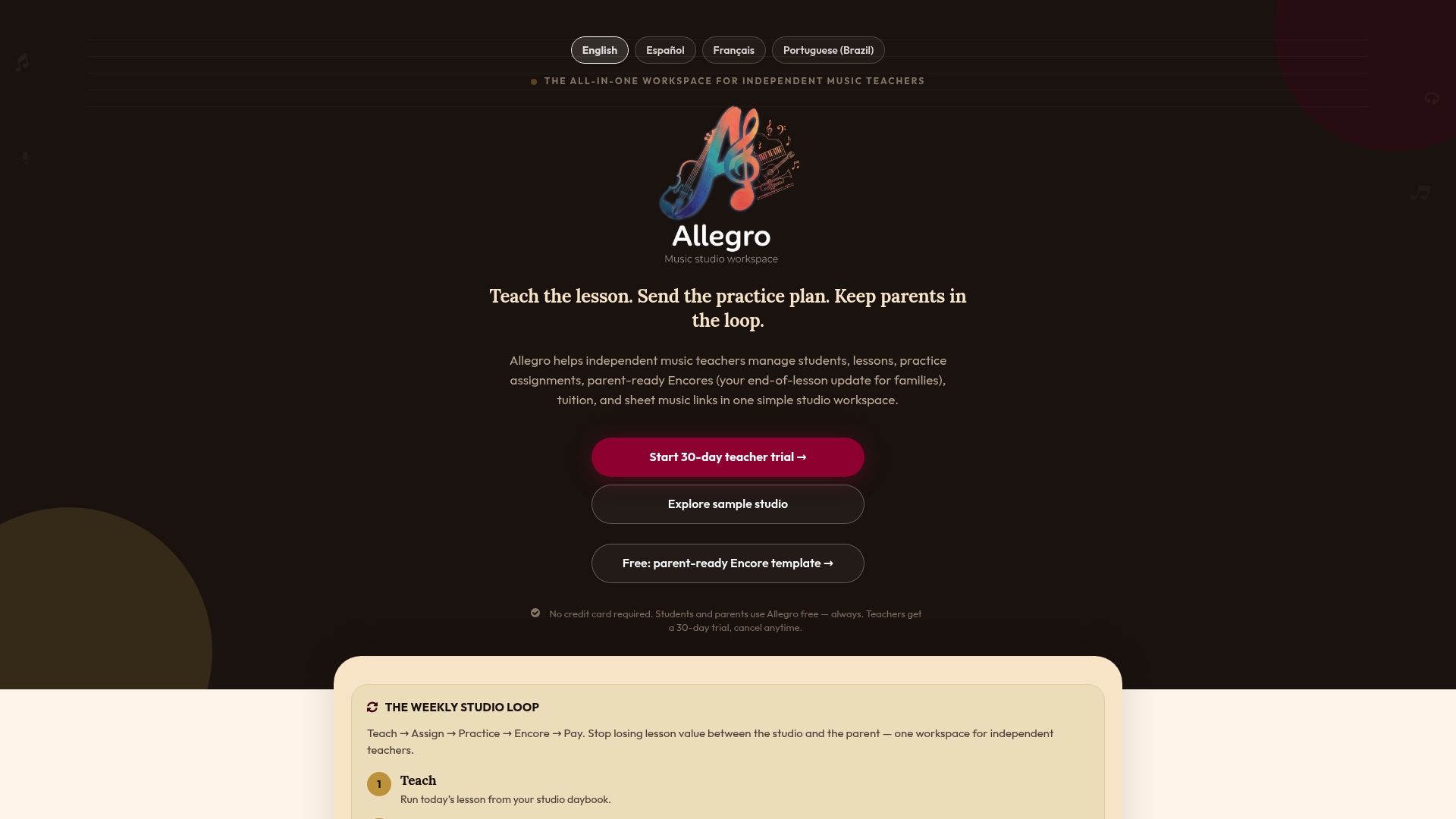
If the checklist above sounds right but you don’t have time to build the templates yourself, that’s exactly the workspace Allegro provides. The Studio plan runs $39 per month and includes the tools to turn first-lesson notes into parent-ready recaps automatically; the Solo plan is available for teachers managing a smaller roster, with pricing available on the site. Start a trial and run your next new student through the full workflow, from intake form to first Encore, before you decide anything.
Sources
- Creating musical playlists for the classroom (Graduate Group in Music - UC Berkeley)
- Welcoming new GSE students through music (University at Buffalo Magazine)
- Employing music as an entry point into classes (peer-reviewed conference paper)
- New Customer Onboarding Checklist for Music Teachers (SkipCalls resources)
FAQ
What Is a Good Welcome Song for New Students?
There’s no single correct answer since it depends on the student’s own taste, which is exactly why a student-curated welcome playlist works better than a fixed song choice. Sending a shared playlist and inviting the student to add a track builds more ownership than picking one song for everyone, a tactic used by universities during their own onboarding sequences.
What Songs Work Well for Starting College or a New Music Program?
Upbeat, familiar tracks tied to the student’s stated genre interests tend to outperform generic “welcome” songs, because they signal the program cares about who the student already is. A short intake question asking for a favorite song or artist gives you exactly what you need to build that first playlist.
How Long Should Student Onboarding Take?
Onboarding can run as a single intake lesson for casual learners or stretch across a structured 4-week program for beginners aiming to build a weekly habit. Either way, pair it with a 4 to 6 week follow-up email sequence so policies and practice tips land gradually instead of all at once.
What Should Happen in the First Lesson?
A well-structured first lesson runs roughly five minutes of rapport building, ten minutes of assessment, twenty minutes of focused teaching toward one quick win, and a short close to confirm the practice plan and next booking. This structure follows the minute-by-minute model used in practitioner onboarding checklists.
Does Allegro Music Studio Help With Onboarding Specifically?
Yes. Allegro centralizes intake details, lesson notes, and assignments, and converts those notes into parent-ready Encores that summarize what happened and what to practice next. The Studio plan costs $39 per month, and the Solo plan’s pricing is available directly on the site.